Your Eye Drops Were Never Going to Fix This. The Real Reason Your Eyes Feel Dry, and the Simple 5-Minute Daily Ritual That Goes After the Actual Cause
If drops only buy you 20 minutes of relief, it's not because your eyes are "just dry". Almost everyone is treating the wrong problem. Here's what's really going on, in plain English, and the simple fix that's been hiding inside expensive clinics.
The day that changed everything
I'll never forget the night I took my wife out to dinner at one of our favorite restaurants.
The lights were low, there were candles on the tables, and about halfway through the evening I noticed something strange. She still had her sunglasses on. Indoors. At night.
When I gently asked her why, she looked down at her plate and said quietly:
"I just don't want anyone asking me if I've been crying again."
That sentence hit me like a punch in the stomach.
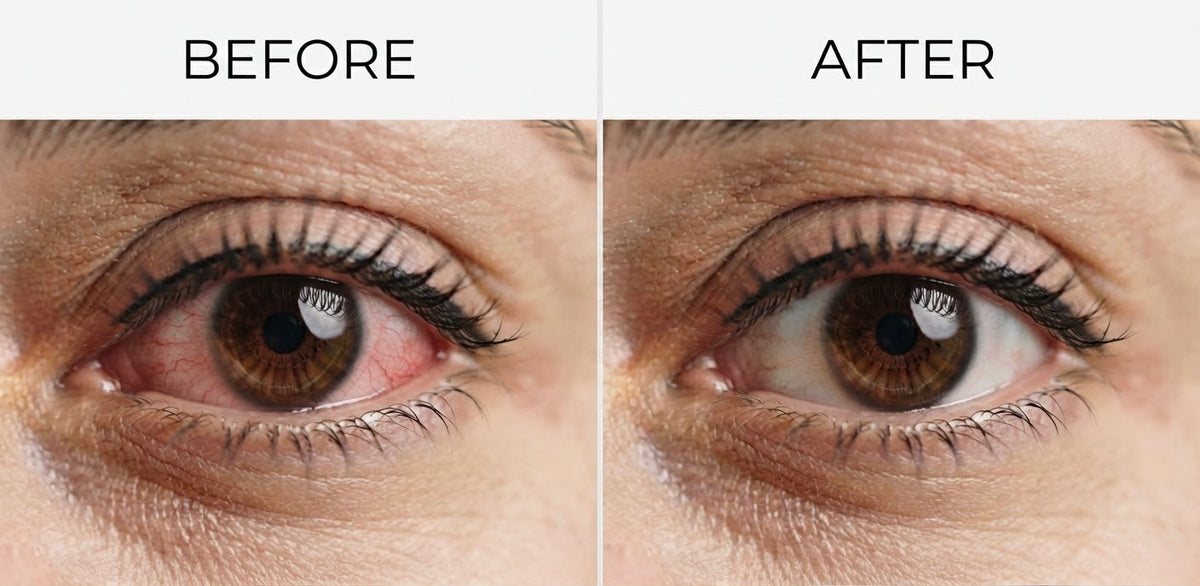
Her eyes had been red, dry and burning for a long time. She kept eye drops in every bag and used them at her desk, in the car and before bed. Nothing lasted more than a few minutes. And slowly, without me even noticing, she had started hiding. Avoiding photos. Cutting evenings short. And now, wearing sunglasses at dinner so strangers wouldn't stare at her eyes.
Sitting across from her that night, I made a decision. I was going to find out what was really going on with her eyes, whatever it took.
If you have dry eyes, you probably know exactly how she felt.
It starts small. A little grit in the corner of your eye around 3 p.m. A sting when you've been staring at your screen too long. You blink harder. You rub. Nothing changes.
By evening, your eyes feel hot and heavy, like you've been awake for two days straight. You want to read in bed, but your eyes won't let you. Night driving turns into a blur of glare and halos. And if you wear contacts, you're counting the minutes until you can take them out.
Be honest. How many of these sound like you?
- Your eyes feel gritty, sandy or burning, especially later in the day
- They get worse in front of screens, in air conditioning or in the car
- You wake up with heavy, crusty or sticky eyelids
- Drops help, but only for a few minutes
- Your eyes water randomly, even though they feel dry
- People tell you that you look tired, even when you're not
If you nodded at two or more, keep reading, because this was written for you.
And yes, eyes that water and feel dry at the same time sounds like a contradiction. It isn't. In a minute you'll see exactly why it happens.
The mind-blowing discovery

I'm not a doctor. I'm a husband who was tired of watching the person he loves suffer. So I went digging.
I read the clinical studies. The eye-doctor guidelines. The research papers with titles longer than this paragraph. I went through every treatment my wife had tried, one by one, and kept asking the same question: why does all of this stop working?
And what I found honestly made me angry.
Almost everything sold for dry eyes is aimed at the wrong problem.
Not slightly off. Completely wrong.
In one large study, up to 86% of people diagnosed with dry eye showed signs of the same hidden problem. And it has almost nothing to do with how many tears you make.
It's not about "drinking more water." It's not about "finding better drops." It's not about "cutting down on screen time."
That's why nothing you've tried has really worked.
The real cause is so simple that once you see it, you'll wonder why nobody ever explained it to you.
Your tears are losing their lid.
Here's what's really going on.
The real reason your eyes are dry (it's not your tears)

Your eyes stay moist thanks to a thin film of tears that covers them all day. That film is made of two layers:
- Underneath: water. That's your actual tears.
- On top: an ultra-thin layer of oil.
The oil has one job: to stop the water from evaporating. Think of it as a lid on a glass of water left out on a hot day. With the lid on, the water stays in. Take the lid off, and the water slowly evaporates until the glass is empty.
That oil comes from 25 to 40 tiny glands lined up along the edge of each eyelid, right by your lashes. Every time you blink, your eyelid gently presses on them, and a tiny drop of oil comes out and spreads over your tears. Blink, seal. Blink, seal. Thousands of times a day.
In healthy eyes, that oil is clear and runny, like olive oil. But in a lot of people it slowly turns thick and waxy, like butter straight out of the fridge. The usual suspects:
- Screens. We blink far less while staring at a screen, and fewer blinks means the glands don't get emptied.
- Air conditioning and heating. Dry air, all day long.
- Age, hormones and contact lenses. All of them can change the oil and how freely it flows.
Thick oil can't squeeze out of those tiny openings. It gets stuck at the opening, like a plug, and the gland clogs.
Now your tears are left without their lid. They're still there, but they evaporate within seconds of every blink. Your eye dries out, starts to burn and feel gritty, and sometimes floods itself with watery tears in a panic, tears that evaporate just as fast. That's the dry-but-watery mystery solved.
This is the hidden problem behind that 86% figure.
In one sentence: your eyes aren't dry because you don't have enough tears. They're dry because the glands that make the protective oil "lid" are clogged, so your tears evaporate almost as soon as you make them.
Once you see it this way, something else suddenly makes sense: why nothing you've tried so far has really worked.
Now look at everything you've tried

Let's go through it, one by one, and look at it through what you now know.
- Eye drops. The first thing everyone reaches for, and they feel great for about 20 minutes. But drops add water, and water was never the problem. Using drops is like topping up that open glass of water on a hot day: it looks full for a moment, but the water keeps evaporating just as fast, and a few minutes later it's empty again. So you use more, and more. Four, five, six times a day, at $10 to $20 a bottle, every month, for years. And many drops contain preservatives that can irritate your eyes when used that often.
- Hot washcloths. Grandma's advice, and actually the right idea: heat is what softens hardened oil. But a washcloth cools down in about two minutes, long before the warmth can travel through the eyelid and reach the glands. So the oil never melts. You stand over the sink reheating it again and again, until you give up.
- Microwave eye masks. Same problem. Too hot when they come out, lukewarm a few minutes later, and they only warm the spots they press on. The glands never get a steady, even dose of heat.
- Fish oil supplements. Months of capsules. Yet when the U.S. National Eye Institute ran a large, year-long study, people taking omega-3 fish oil did no better than people taking a placebo. A capsule does nothing for the oil that has already hardened inside the glands.
- Humidifiers, gels, blue-light glasses, fewer screen hours. They make the air or the surface of your eye a little more comfortable, at best. None of them unclogs the glands, so none of it lasts.
Here's the thing: none of this is your fault. Almost everything you've been told to try either pours water into an open glass, or brings heat that's gone before it can do its job. None of it actually melts the hardened oil and puts the lid back on your tears.
So why did nobody tell you this?

Part of it is simple: drops are the easy answer. They're quick to recommend, they're sold everywhere, and they really do make your eyes feel better for a few minutes. Checking the oil glands takes special tools and extra time, so many people with dry eyes never have theirs looked at.
But there's a bigger reason, and it's less comfortable to say out loud.
Eye drops are a huge business. People around the world spend billions of dollars on them every single year. And for the companies selling them, a drop that only works for 20 minutes isn't a flaw. It's the business model. A bottle that wears off by lunchtime is a bottle you'll be back to buy next month. And the month after that. For years.
Think about it. If something actually unclogged your glands, you'd buy it once and be done. A drop that soothes the surface for a few minutes keeps you coming back forever. Which one do you think gets the TV ads, the shelf space in every pharmacy and the endless "new and improved" formulas?
No one has to hide anything. The system simply rewards the product you keep rebuying, not the one that fixes the problem. So the advice never changes: "use more drops." And millions of people stay stuck, reaching for the bottle five times a day, convinced their eyes are just broken.
They're not. They've just been treating the wrong problem.
So what actually works? Once you understand the real problem, the answer turns out to be surprisingly simple.
The real fix: melt the oil, then let it flow

If hardened oil is the problem, the answer is to melt it.
Think back to that butter straight out of the fridge. Leave it somewhere warm for a few minutes and it softens all by itself. The oil in your eyelid glands works the same way. Warm it up properly, and it turns soft and runny again, so it can finally flow out and do its job.
But "properly" is the key word. When I dug into the research, I found that melting that oil isn't one thing. It's a few things that all have to happen together:
1. Reach the right temperature. The glands need to get to roughly 40°C before hardened oil starts to soften. Any cooler, and nothing happens. Much hotter, and you irritate the delicate skin around your eyes.
2. Hold it there long enough. Heat doesn't jump straight to the glands. Research shows it needs at least 4 to 6 minutes to travel through the eyelid and reach them, and the temperature has to stay steady the whole time.
3. Warm the whole eyelid evenly. The glands run along the entire edge of each lid. Heat that only touches a few spots leaves the rest of them clogged.
4. Let the oil flow out. Once it has softened, a few slow, gentle blinks press it out of the glands and spread it back over your tears. That's the moment the "lid" goes back on.
5. Do it every day. The glands can clog again, so a few warm minutes every day keeps the oil flowing instead of letting it harden all over again.
Miss just one of these steps and nothing really changes. That's exactly why the washcloth never worked: it gets close to the right temperature for a minute or two, then cools down long before step 2 is even halfway done.
So why couldn't she just do this at home?

When I laid it all out, the frustrating part was obvious. None of this is complicated. But there was nothing at home that could actually do all five steps.
Washcloths go cold in two minutes. Microwave masks start too hot, then cool down, and only warm the spots they press on. The few machines that really get it right sit in specialist clinics, with price tags most people will never pay.
So I set out to build something that could, for her, and for everyone stuck in the same cycle of drops. Not another gadget that just feels warm, but something designed around exactly those steps.
The temperature. We set it at 41.5°C, just above what the glands need and still gentle on the eyelid, and made it hold that temperature steady instead of starting hot and slowly cooling down.
The time. Every session runs for a full 5 minutes, long enough for the warmth to travel through the lid and reach the glands.
The even warmth. Instead of a heated pad, we chose a fine warm mist. As the tiny warm droplets touch your eyelid, they release their heat right there, evenly, across every curve of the lid, with nothing touching your eye.
After that, a few slow blinks do the rest: the softened oil spreads back over your tears, the protective lid is back, and your eyes can finally hold on to their own moisture.
Melt. Flow. Seal. That's the whole idea in three words.
1. Melt: steady warmth softens the hardened oil inside the glands.
2. Flow: once it's soft, every blink can push it out again.
3. Seal: the oil spreads over your tears, the lid is back, and your tears stop evaporating.
And after years of development, i think i have finally found the solution to dry eyes.
Meet HydraMist

HydraMist is a small, cordless device built around one goal: bringing the principle behind clinic heat treatments into your home.
It surrounds your closed eye with an ultra-fine, warm mist, holds it at a steady 41.5°C for a full 5 minutes, and then switches itself off. That's it. No guessing, no reheating, no appointments. Melt, flow, seal, every single day.
The first thing you notice about HydraMist is how simple it is. It fits in one hand, there's no cord, and there's exactly one button. No app, no settings, no thick instruction booklet.
What you don't see is everything that went into getting the details right. The hardest part was the temperature. A lot of "warm" products start out hot and then quietly cool down, which is exactly why washcloths and heated masks never really worked. HydraMist holds 41.5°C from the first second to the last, so the warmth actually has time to make its way through the eyelid to the glands.
And instead of dry heat, it uses an ultra-fine mist. When those tiny warm droplets touch your eyelid, they release their heat gently and evenly, across every curve, and leave behind a soft layer of moisture that tired eyes really appreciate.
Using it is the easy part. You pour a little water into the tank, press the button, and within a few seconds a gentle, warm mist starts to flow. You rest the soft eyecup over one closed eye, lean back and breathe. Nothing ever touches the eye itself.
For five minutes, you just feel the warmth slowly spreading across your eyelid. Then it switches itself off, you do the other eye, and blink slowly a few times so the softened oil can spread back over your tears. It fits easily into your day, whether that's with your morning coffee or as part of winding down before bed.
It charges with a simple USB cable and runs on plain water, so there's nothing to refill and nothing you have to keep buying. Cleaning takes a few seconds, and it's small enough to live on your nightstand or come with you when you travel.
Honestly, that's what I love most about it. It doesn't ask much of you. Five quiet minutes a day, and it goes after the real reason your eyes feel the way they do, instead of covering it up for twenty minutes at a time.
And because you can use it every day, you're not just melting the blockage once. You keep the glands flowing, day after day, instead of letting them clog up all over again.
And my wife? Remember that dinner, the one where she wouldn't take off her sunglasses?
These days, when we go out to dinner, the sunglasses stay at home.
I built HydraMist because of her. I'm sharing it because I know she isn't the only one hiding behind a pair of sunglasses.
50% off today · Free tracked shipping
What to expect
Let's be realistic, because you've had enough empty promises.
- Your first session: deep, soothing warmth around your eyes, and a calm, refreshed feeling when you open them. Most people find it's the most relaxing five minutes of their day.
- The first week: you're softening oil that may have been hardening for months, or years. Use it once a day and let it work.
- Weeks 2 to 3: this is where consistency pays off. Daily warmth keeps the glands flowing instead of letting them clog again, which is why we give you a full 30 days to judge it.
No miracle overnight. Just the right heat, for the right amount of time, every day, aimed at the actual cause.
You might be wondering...

"Is it safe to use near my eyes?"
Your eye stays closed the entire time, and nothing touches the eye itself. The mist stays at a gentle 41.5°C, similar to a warm compress, and the device switches itself off after 5 minutes. If you have an eye infection, a diagnosed eye condition or recent eye surgery, check with your eye doctor first.
"I've tried everything. Why would this be different?"
Because almost everything you've tried was aimed at the wrong target. Drops add water. Washcloths and masks lose their heat too soon. HydraMist is built around the temperature and the time the glands actually need. And you don't have to take our word for it: you have 30 days to find out for yourself.
"I'm not good with gadgets."
Water in, one button, eyes closed. If you can make a cup of tea, you can use HydraMist.
"Can I still use my drops?"
Of course. Keep anything your doctor prescribed. Many people simply find they reach for them less once the real cause is being taken care of.
Now you probably have one last question…
How much does it cost?

Let's put it in perspective.
- A year of eye drops: $120 to $240, every year, for relief that lasts minutes.
- One in-clinic heat treatment: $700 to $1,500, often repeated every year or two.
When we created HydraMist, we priced it at $140, already a fraction of a single clinic visit.
But we kept coming back to one thought: the people who need this most are the ones who've already spent a fortune on things that didn't work. We didn't want price to be the reason someone keeps suffering.
So we cut the price in half. Right now, HydraMist is just $69.90.
That's about what you'd spend on eye drops in a few months, for something that goes after the actual cause, runs on nothing but water, and is built to last for years.
Free tracked shipping · 30-day money-back guarantee
And you can try it for 30 days, risk-free

We know you've been burned before. So here's our promise.
Use HydraMist every day, as directed, for at least 21 days. If your eyes don't feel better, or you simply don't love it, contact us within 30 days of delivery and send it back for a full refund of your purchase price. You'll find the simple steps in our Refund Policy.
You also get free tracked shipping and a 1-year warranty.
The risk is on us. The only thing you can lose is another month of reaching for the drops.
From here, there are two ways this can go
Keep buying drops that evaporate in 20 minutes. Keep rubbing your eyes at your desk, cutting evenings short and hiding behind sunglasses so nobody asks if you've been crying. Maybe one day pay $1,500 for a clinic treatment you'll need to repeat. Keep spending money on a problem that never actually gets fixed.
Pay $69.90 once. Give your eyes 5 warm minutes a day. Melt the blockage that's been drying them out, and let your own tears do their job again. And if it's not for you, send it back within 30 days for a full refund.
One path costs you more every single month. The other costs $69.90, once, with a money-back guarantee. The choice seems pretty obvious.
Free tracked shipping · 30-day money-back guarantee
P.S. Still deciding? Here's the short version: your eyes are most likely dry because the oil glands in your eyelids are clogged, not because you lack tears. That's why drops wear off so fast. Eye clinics charge up to $1,500 to melt that blockage with controlled heat. HydraMist puts the same principle in your hands, 5 minutes a day, for $69.90.
P.P.S. Remember, you have 30 days to try it. If it's not for you, send it back for a full refund. The only real risk is another year of drops that stop working before lunch.
To your eyes,
Richard Thompson
Today: 50% OFF HydraMist
UPDATE: Every order today includes free tracked shipping and our 30-day money-back guarantee.
Everything a clinic heat treatment is built on, in your hands every day, for less than a few months of eye drops.
NOTE: Only available from our official store.

Get HydraMist at 50% OFF Today, Risk-Free!
Claim My Discount →